
Profit intelligence built for action.
Understand product margins, account for configured tax, recognize meaningful profit risks and explore stronger business decisions. MarginLab brings your store economics into one connected system without turning every fluctuation into an emergency.
Focus on meaningful improvements instead of treating normal business fluctuations as daily emergencies.
Understand store revenue, product costs, profit and relevant margin signals.
Compare product margins, identify missing costs and recognize weaker performers.
Understand how configured tax treatment affects underlying product profitability.
Explore AI guidance, recovery scenarios and forecasting when deeper analysis is needed.
Everything connected.
Every decision clearer.
Start by understanding store and product profitability. Add advanced analysis when you need deeper guidance, stronger monitoring and better-informed decisions.
Understand what is happening.
See store profitability, margin performance and meaningful business signals.
STORE OVERVIEWUnderstand product margins, missing costs and weaker performers.
PRODUCT ECONOMICSRecognize meaningful profit risks, margin changes and business priorities.
PROFIT SIGNALSStay informed with product alerts, PDF reports and CSV exports.
CONTINUOUS VISIBILITYSeparate configured tax components from the underlying economics of your products.
Decide what to improve.
Ask deeper questions about profitability, product risks and opportunities.
AI GUIDANCEExplore potential pricing and cost changes before making decisions.
SCENARIO ANALYSISExamine future profitability assumptions and potential business direction.
FORWARD PLANNINGOrganize relevant profitability signals without unnecessary daily noise.
ADVANCED MONITORING
See your store clearly.
Understand what deserves attention.
Bring store profitability, product risks and relevant business signals together in one connected view. Included in both Starter and Growth.
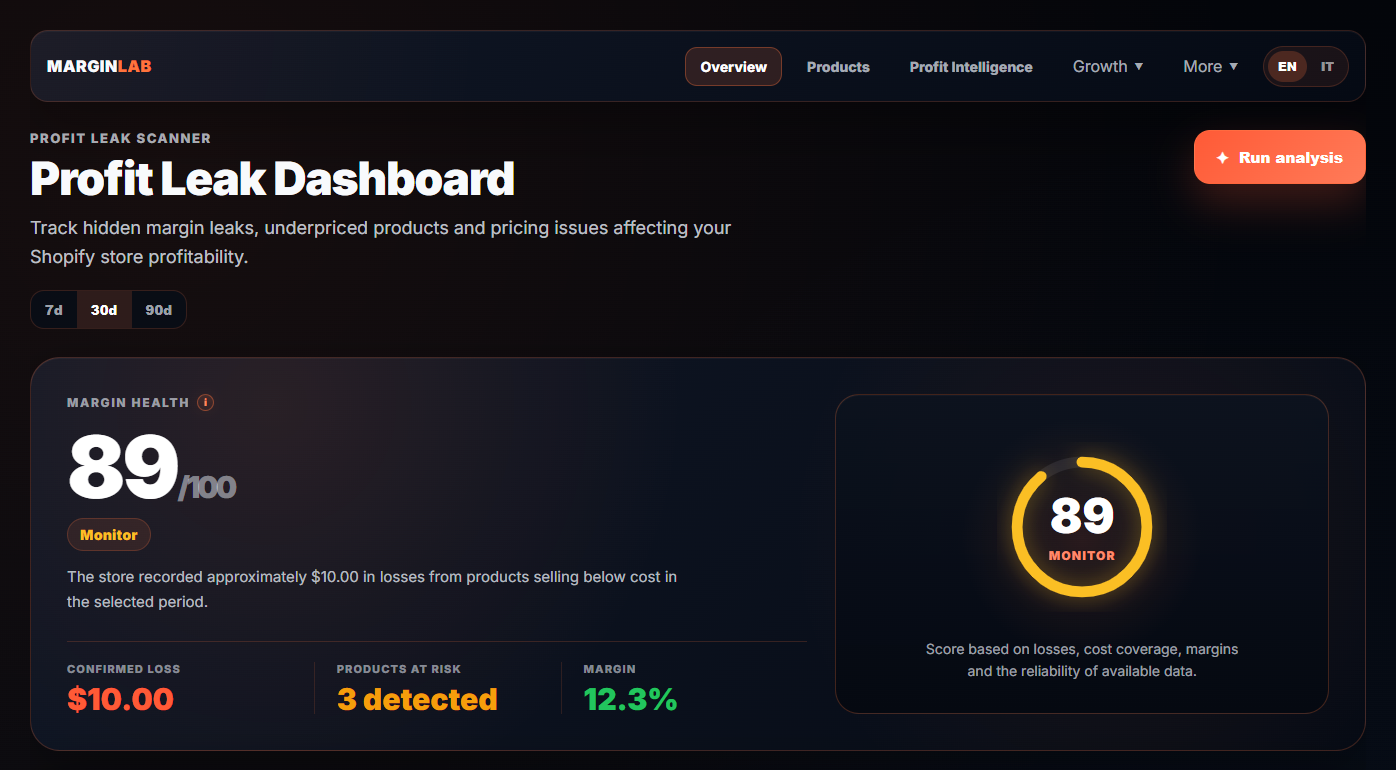
Understand profitability.
Review product margins, overall performance and changes across your selected reporting period.
Recognize what needs review.
Identify weaker products, missing cost information and sales that deserve closer attention.
Look beyond gross amounts.
Understand how configured tax treatment affects the underlying economics of your products.
The numbers matter.
Understanding them matters more.
Profit Intelligence connects product performance, incomplete costs and relevant business exposure so you can recognize what deserves attention without treating every fluctuation as an emergency.
Every product sells.
Not every product pays.
Understand which products contribute meaningful profit, which require review and where missing costs prevent reliable decisions.
INCLUDED IN STARTER AND GROWTHSee the products behind your profit.
MarginLab connects revenue, product costs, margins and risk signals so you can recognize what deserves attention without searching across disconnected reports.
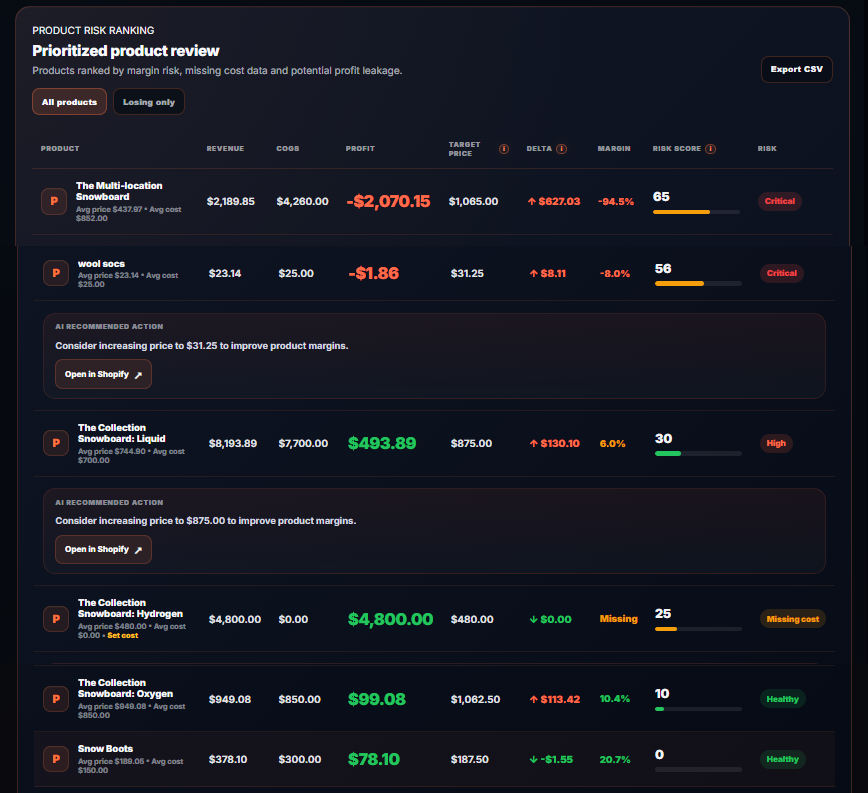
Products generating negative profit or showing significant margin weakness.
REVIEW PRODUCT ECONOMICSProducts generating sales while retaining a comparatively weak margin.
CHECK PRICE AND COSTProducts that cannot be assessed confidently without essential cost information.
ADD PRODUCT COSTProducts with stronger economics that can be monitored without unnecessary urgency.
CONTINUE MONITORINGMarginLab helps separate strong performers, weaker margins and missing data so your next decision is based on product economics rather than sales volume alone.
Ask better questions.
Make better decisions.
Explore your store profitability through structured analysis and focused questions, with answers connected to the business signals MarginLab has already identified.
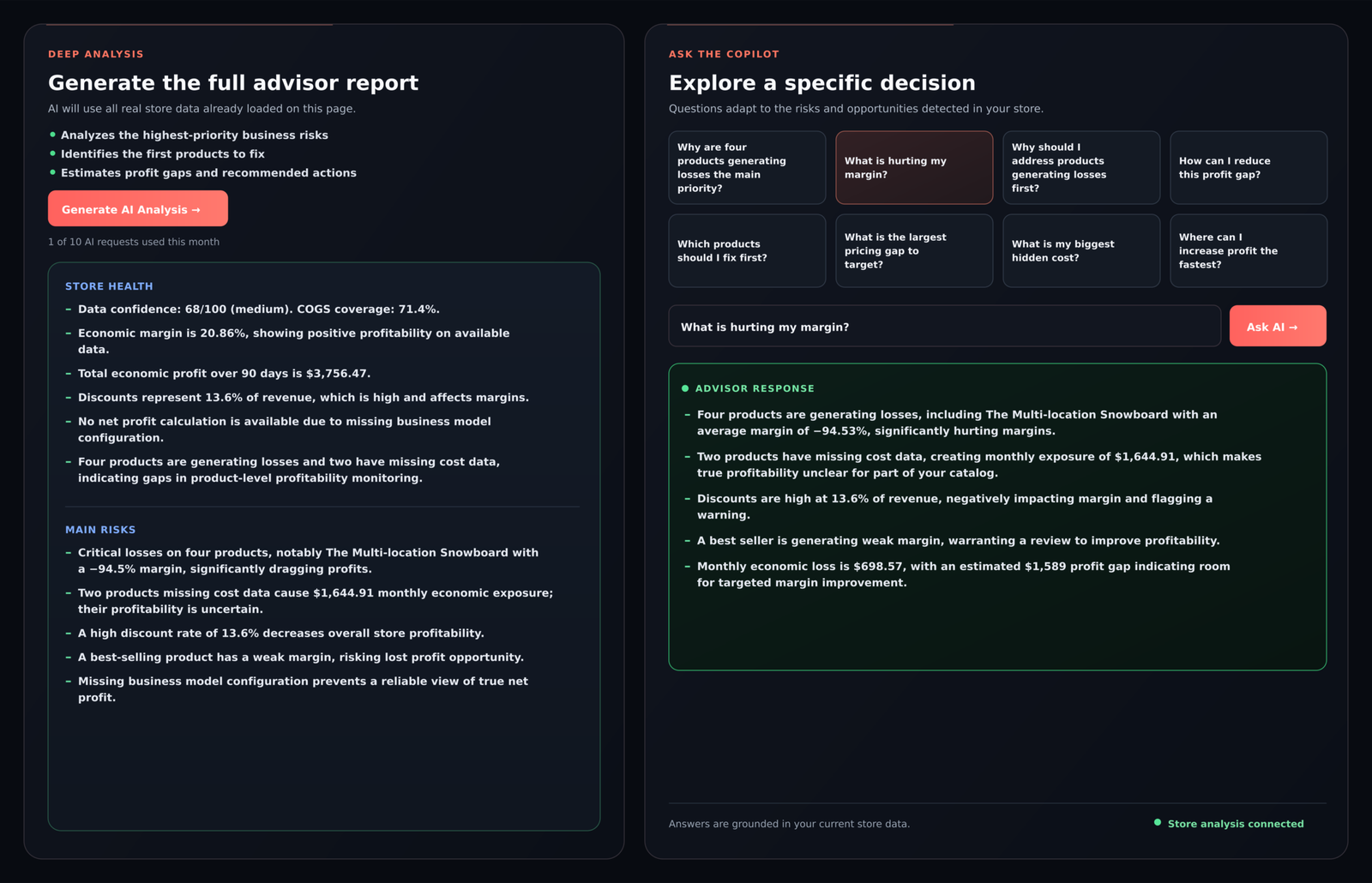
Understand the whole picture.
Generate a structured interpretation of your store’s profitability, product risks and business priorities.
Investigate a specific decision.
Ask practical follow-up questions about products, margins, missing costs or recovery opportunities.
See the opportunity. Before you change anything.
Test controlled changes to price, product cost and sales volume. See how a realistic scenario could affect margin and retained profit before making a live decision.
What could this product earn with a better decision?
Start with the product’s actual economics. Adjust the assumptions, compare possible outcomes and understand whether the opportunity is worth pursuing.
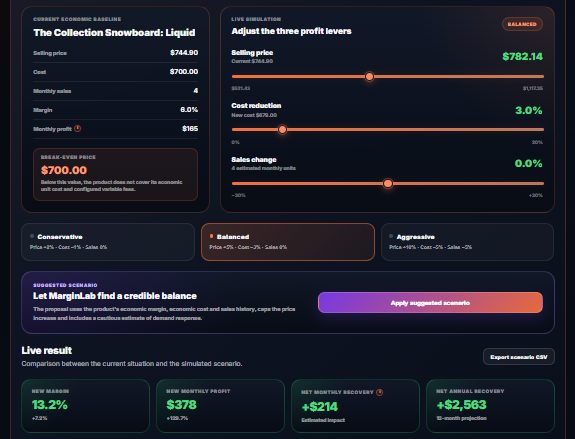
Start from the real numbers.
Review the selected product’s current selling price, cost, margin and monthly sales.
Test a realistic adjustment.
Modify price, cost or volume, or compare Conservative, Balanced and Aggressive presets.
See what could improve.
Compare projected margin, monthly profit and estimated annual recovery before acting.
See what changed. Know what matters.
Keep product profitability, missing costs and meaningful risks visible over time. Review the signals with real business impact without treating every normal fluctuation as an emergency.
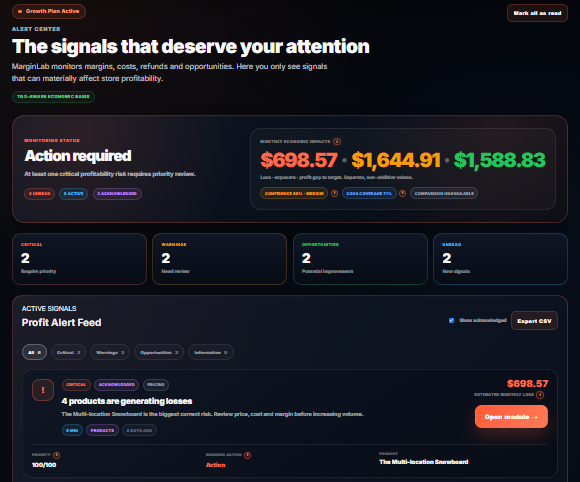
Pay attention to the issues that actually change profit.
The Growth Alert Center organizes detected losses, missing product costs and recovery opportunities into a clearer view of what deserves review first.
Products losing money
Review products where the available numbers indicate a real loss.
Missing product costs
Identify incomplete cost data before relying on profitability conclusions.
Recoverable profit
Spot products where pricing or cost review could improve the outcome.
Changes worth tracking
Keep relevant margin signals visible while stable products stay monitored.
Understand what is happening.
Review profitability, product-level risks and available reporting through the dashboard, product alerts and CSV/PDF exports.
See what deserves attention first.
Use the Alert Center to bring relevant signals, estimated impact and product priorities together in one focused review.
Not every amount collected belongs in your profit.
Configure how MarginLab interprets your tax regime, selling prices, product costs and input-tax recovery so profitability reflects a clearer economic basis.
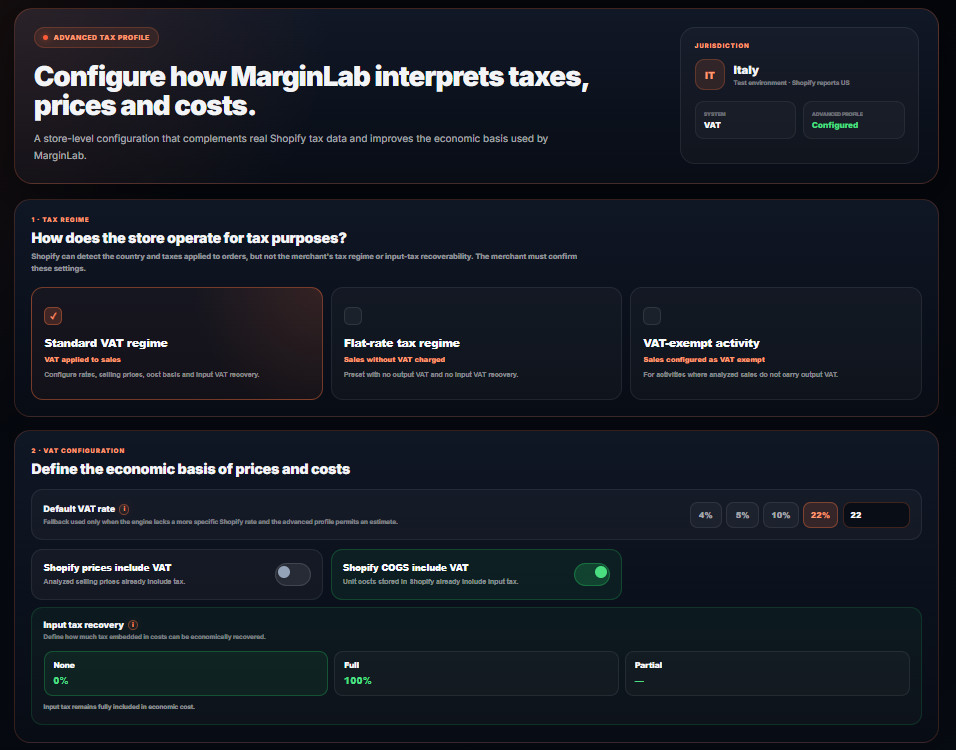
Understand the tax behind your numbers.
Shopify order totals and product costs do not, by themselves, explain how a merchant’s configured tax treatment affects underlying economics. MarginLab uses the selected profile to interpret those numbers more carefully.
Tax regime
Define whether the store uses standard VAT, a flat-rate tax regime or VAT-exempt activity.
Selling price treatment
Indicate whether recorded selling prices already include VAT and configure the relevant rate.
Product cost treatment
Specify whether Shopify product costs include VAT before relying on the resulting margin.
Input-tax recovery
Reflect whether input VAT is economically recoverable according to the configured profile.
From collected amounts to clearer profitability.
The selected tax settings help determine the economic treatment applied to revenue, product cost and resulting profit.
Clear answers. Before you connect.
Understand what MarginLab analyzes, how the tax-aware engine works, what the advanced features actually do and which decisions remain under your control.
01 What does MarginLab actually analyze?
MarginLab analyzes the Shopify order, product and cost information available to the app, including revenue, Cost of Goods Sold, product profitability, margin, discounts, refunds and relevant product-level risk signals.
The usefulness of the analysis depends on the completeness and reliability of the connected store data.
02 What happens if a product cost is missing?
MarginLab identifies missing product costs as a data-quality issue. Without a reliable cost, the app cannot determine the product’s true profit or margin with confidence.
A missing cost is not treated as proof that a product is profitable or unprofitable.
03 How does the Tax-Aware Profit Engine work?
The Tax-Aware Profit Engine uses the configured tax profile to interpret the relevant treatment of selling prices, product costs, VAT and input-tax recovery. This helps MarginLab calculate profitability on a clearer economic basis.
The engine is included in both Starter and Growth. Its results depend on the settings selected by the merchant and do not replace accounting or professional tax advice.
04 Does MarginLab automatically change Shopify prices or costs?
No. MarginLab analyzes profitability, highlights product risks and supports scenario evaluation, but it does not automatically change your live product prices, costs or discounts.
You remain responsible for every business decision and every change made in Shopify.
05 How does AI Advisor Pro use my store information?
AI Advisor Pro uses the profitability signals analyzed by MarginLab to explain store health, identify the main risks, suggest what to review first and answer questions about the current business situation.
It provides interpretation and guidance; it does not make automatic decisions or guarantee a particular result.
06 Does the Recovery Simulator guarantee additional profit?
No. The Recovery Simulator estimates how selected changes to price, product cost or sales volume could affect margin and potential profit using the available product information.
Actual outcomes can differ because demand, customer response, discounts, refunds and future business costs may change.
07 Will the Alert Center turn every change into an emergency?
The Growth Alert Center is designed to organize meaningful product losses, missing costs, estimated economic exposure and relevant recovery opportunities. Its purpose is to help merchants distinguish material business signals from routine fluctuations.
Stable performance can remain monitored without requiring unnecessary intervention.
08 What is the difference between Starter and Growth?
Starter includes the core profitability foundation: Dashboard, Product Analysis, Profit Intelligence, the Tax-Aware Profit Engine, product email alerts and available CSV/PDF exports.
Growth includes that foundation and adds advanced features such as AI Advisor Pro, Recovery Simulator, Alert Center, Forecasting and Profit Assumptions.
09 Can I try MarginLab before paid billing begins?
The Starter plan includes a 14-day free trial through Shopify’s billing process, allowing you to review the available features before the paid subscription begins.
Subscription approval, billing and cancellation are managed through Shopify.
See your store clearly. Decide with confidence.
Connect your Shopify store and bring product margins, configured tax treatment, meaningful risks and improvement opportunities into one connected profitability workflow.